
Remarketing is the targeting strategy of using custom audiences to reach people who are closely aligned with the brand. These audiences generally reflect website visitors, email subscribers, paying customers, engagement with Facebook and Instagram accounts, and actions on owned applications.
How Things Were
Before custom audiences, life as a Facebook advertiser (as we were called then) was far more difficult. We had full control over defining the audience we’d reach with our ads, which was a critical responsibility. But we were limited to things like interests, behaviors, and demographic data.
Custom audiences changed everything. It started with the ability to upload our email list so that we could target them with ads. But website remarketing may have been the most transformational.
Understand that the pixel today is not what we had back then. Previously, we’d add a conversion pixel to specific pages to help with tracking those results. But it wasn’t used for targeting. We created a separate pixel for that.
And initially, this could only be done with third-party tools. But eventually, website remarketing gave us some of the most powerful access to targeting available. We could target people based on specific pages they visited, events they performed, and the amount of money they spent. Eventually, we could create custom events and target people based on scroll depth, time spent, and unique actions performed.
There was no greater advantage than a large remarketing audience. You could eliminate all of the people who don’t know who you are and only spend on people who recognize your brand. It was cheap and effective.
Part of the reason it was so cheap was that advertising, generally, was cheap. We usually spent more to reach our remarketing audience, but it didn’t matter.
What Changed
Quite a lot has changed since those days. While the people in our remarketing audiences remain potentially valuable, the ways we reach them have evolved for most of us.
It’s first important to understand that costs to simply reach people have multiplied since the old days. If you’re already spending more to reach someone via remarketing, the ease of profitability starts disappearing quickly.
But there are many other factors that have impacted the necessity to use remarketing strategies.
Algorithmic targeting is a big one. When Meta introduced Advantage+ Audience, they made something clear: If you don’t provide audience suggestions, Meta will still prioritize people based on pixel activity, conversion history, and prior engagement with your ads.
You know what that is? It’s remarketing. And Meta’s doing it automatically.
We can now prove that with Sales campaigns using audience segments. Assuming you’ve defined your Engaged Audience and Existing Customers in Advertising Settings, you can perform a breakdown to see how your budget was distributed.
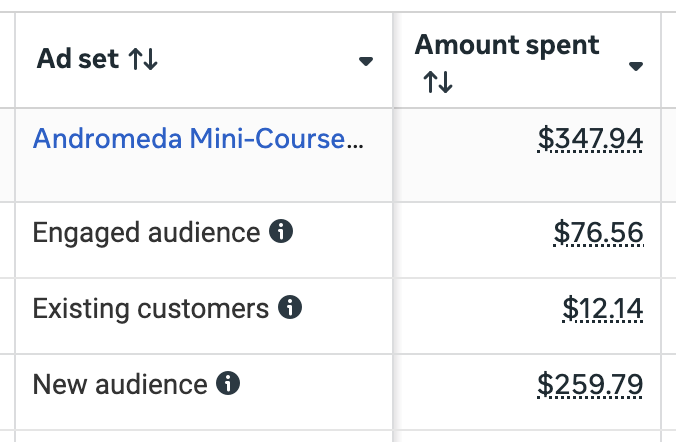
You’ll often see that 5, 10, 20, and even 30% of your budget is spent on your remarketing audience — all while using algorithmic targeting and no targeting inputs. But what makes this method especially interesting is that Meta will reach both remarketing and prospecting audiences simultaneously, balancing costs and distributing your budget optimally between them.
When you do this manually, you will exhaust your remarketing audience. You’ll lose track of how much you should spend from day to day without driving up frequency and costs.
Something else that happened during the past few years is that Meta provided tools to help us question just how valuable some of our remarketing efforts were and are. It’s not that reaching people connected to us isn’t valuable. But it’s very easy to inflate the value of remarketing results.
This is most obvious when viewing our view-through conversion results. It turns out that it’s quite likely a high percentage of our “amazing results” back in the day were from view-through conversions. This means that someone was shown our ad, didn’t click, and then converted within a day. This often happens when we reach them in other ways (like email).
So we’ve learned that the remarketing audience is technically valuable, but it’s not scalable or incremental. We need a balance of remarketing and prospecting to get the best, long-term results.
How to Approach Custom Audiences and Remarketing
For years, I was known for my remarketing strategies. I did things no one else did, and the creative strategies I could use to reach my remarketing audiences energized me. So it wasn’t easy for me to accept that what I long did was no longer relevant.
It wasn’t until I was able to prove it with the breakdown by audience segments that the lightbulb went off. I previously used remarketing because I believed Meta didn’t otherwise know who the most important people were. But this was no longer the case, and Meta was already reaching these people automatically.
Our remarketing audiences remain valuable. But we rarely need to explicitly target them now. Meta will prioritize them anyway using algorithmic targeting, and this is a much more efficient way to distribute budget optimally between remarketing and prospecting audiences.
Advertisers will fight me on this because they think they can prove the effectiveness of remarketing with their results. But understand that many of these people would have converted without your ads, especially those represented by view-through conversions. And the most valuable people in that group would have been reached algorithmically anyway.
There are always exceptions when it can make sense to use remarketing to isolate a specific, high-value group. But these are exceptions, usually related to high-ticket sales to help your other marketing efforts. You don’t need general remarketing anymore. And once you accept that, things become much easier.
If you struggle to embrace remarketing-free advertising, I encourage you to do a couple of things.
First, evaluate your “amazing” remarketing results. Use the Compare Attribution Settings feature and isolate the view-through conversions. What do those results look like when you remove them?
Second, start to understand how much remarketing is happening naturally.
- Define your audience segments in Advertising Settings
- Run a Sales campaign
- Use the breakdown by audience segments
You may be surprised by what you see. Seeing these things completely opened my eyes and led me to the hard decisions of changing strategies I long embraced. They may do the same for you, too.
Power Hitters Club
What You Learned Today Could Change Tomorrow
I’ve been covering Meta ads since 2011. If there’s one constant, it’s that nothing stays the same. The targeting rules in this course are accurate now, but Meta is always evolving — and the advertisers who fall behind are the ones who stop paying attention. Inside Power Hitters Club – Elite, I host weekly strategy sessions, maintain living Ad Briefs that I update as the platform changes, and run a private community where hundreds of advanced advertisers share what’s working right now. It’s how I stay current, and it’s how my members do, too.

