
Location targeting is the process of selecting the countries, regions, or cities that you want to be eligible for your ad audience. While location relevance is certainly important, how this is addressed and the control advertisers have over it has evolved significantly.
How Things Were
Years ago, advertisers had four options when defining location targeting:
- People living in or recently in this location
- People living in this location
- People recently in this location
- People traveling in this location
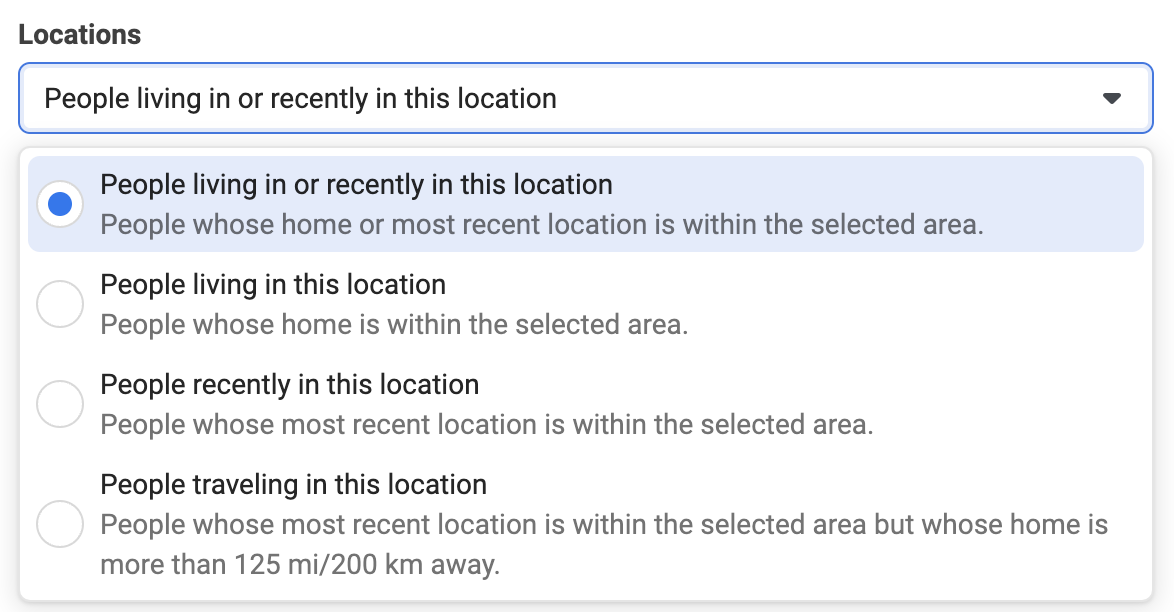
This gave advertisers quite a bit of control. We could isolate only locals if our business or service were only relevant to residents. Or we could isolate those traveling in the area if we wanted to appeal to tourists.
When we defined a country, region, or city for targeting, we could be reasonably confident that our ads were shown to the people who were relevant based on location.
What Changed
A whole lot has changed since then.
The first is that the only option is to target people “living in or recently in” a location.

This is a big deal because advertisers can no longer isolate locals or travelers. We’re going to reach both.
The other major change happened when targeting specific regions or cities. By default, Meta checks a box to expand your audience and reach people who have shown interest in that location.

You can uncheck that box, of course, but it’s also easy to miss. The bottom line is that there is far less control over the people you reach by location. The most reliable option is reaching people by country, but even that can be influenced by the “living in or recently in” dynamic.
The reasoning behind all of these changes likely has more to do with data more than anything else. In the early days of Facebook, the value of the information in someone’s profile was much higher. When someone said they were from New York, they were likely from New York.
Combined with changes in privacy and location settings, the data Meta has around a given user’s specific location is likely less reliable than it once was.
How to Approach Location Targeting
Admittedly, our options here are limited. We have to work with the system that we have.
If your business caters only to local residents (think politics, schools, services for homeowners, etc.), you can’t technically isolate people who live in a location. If your business caters to tourists (hotels, car rentals, etc.), you can’t technically isolate those who are traveling.
But this is where ad copy, creative, the optimized event, and Meta’s dense amount of data come into play. Be very clear about who your ad is for in your copy and creative. If your product is noticeably desirable for one group and undesirable for another, Meta should be able to pick up on that and adjust accordingly.
The problems come in when optimizing for any top-of-the-funnel action. If you optimize for link clicks, landing page views, post engagement, or video views, Meta won’t sort “good” engagement from “bad.” If you want to reach locals but travelers engage with your ads, you’ll reach more travelers.
But if you optimize for a conversion, things should be different. If you want purchases and only one segment is buying from you, that’s information that Meta should learn from.
It’s inexact and frustrating, but we don’t have other options. Do what you can in your copy and creative to call out the people you want to appeal to. And try to exert any control you can over who completes the action that you’re optimizing for.
Power Hitters Club
What You Learned Today Could Change Tomorrow
I’ve been covering Meta ads since 2011. If there’s one constant, it’s that nothing stays the same. The targeting rules in this course are accurate now, but Meta is always evolving — and the advertisers who fall behind are the ones who stop paying attention. Inside Power Hitters Club – Elite, I host weekly strategy sessions, maintain living Ad Briefs that I update as the platform changes, and run a private community where hundreds of advanced advertisers share what’s working right now. It’s how I stay current, and it’s how my members do, too.

