While sales may be the ultimate goal, Meta ads for lead generation are often the best use of ad dollars for brands wanting to make a difference. That is, of course, as long as you prioritize building your list with quality leads.
The cost per lead tends to be a fraction of the expected cost for a purchase. While that cost will vary based on industry and offer, a steady focus on lead generation and list building can be an excellent long-term strategy.
Such a strategy doesn’t come without pitfalls, of course. While it is generally easy to tell when e-commerce ads are failing (they aren’t leading to sales), it tends to be far less obvious with lead generation.
This is what makes Meta advertising for lead generation such a science. You want leads, but not the cheapest leads. You want quality leads, but without jacking up your costs in the meantime.
An inexperienced advertiser is most likely to miss the signs of problems, and they’re also most likely to overlook the actual cause and misapply solutions. In this post, I hope to clarify what to prioritize and how to approach lead generation to get the most out of it.
Lead Costs
Do not chase the lowest cost per lead. The reality is that a lead might cost less than a dollar or it could cost hundreds of dollars. What matters is what that lead is worth to your business.
Lead generation will look different depending on the business. If you offer a professional service and a sales team will contact new leads in an attempt to convert them, it will be easy to assign lead value. What percentage of your leads convert? What’s the average revenue generated by those conversions?
It’s less obvious when building a list with lead magnets. You are offering something of value in exchange for joining your email list. The amount of lifetime revenue produced by a lead may not be known for months or even years. This makes the measurement of lead value challenging.
And some offers fall in between. The lead magnet may be a free webinar. On that webinar, there will be a sales pitch. What percentage of leads attended the webinar? What percentage made the eventual purchase? Of course, even in this case, the door may not be closed on sales following that pitch.
The main point is that you should do some work to determine what a lead is worth to you. Track these leads the best you can to see what they do after filling out your form. Try to apply an average lead value so that you have a goal for what a lead should cost you.
If the quality of those leads is an issue, you’re more likely to run into a problem with the costs not matching up with the returned value. But there are solutions you should consider.
Website vs. Instant Form
Should you run lead ads that utilize instant forms or send people to a landing page on your website? Is one more likely to result in low-quality leads?
The general assumption is that instant forms generate more and cheaper leads, but at a lower quality. This would make sense since they provide less friction and are easier to complete. But I wouldn’t assume it to be the case (my own tests do not reflect this quality drop-off).
Each approach has its own benefits. Instant forms are ideal when either website performance is a problem or you want to skip the step of designing a landing page. Website forms may be preferred when you want the traffic on your website.
The reality is that quality can be controlled from each one. Instant forms actually provide more built-in options for controlling quality that would require custom coding on a website. Don’t assume instant forms generically provide lower quality leads without trying these options.
My personal preference is website forms. The main reason is that my CRM will not accept opt-ins via third-party apps from people who previously opted out. Since my business is 15 years old, it’s a relatively common scenario. So I need an embedded form on my website to ensure they’ll get my emails.
The other reason I prefer website forms is control. I want people on my website. I want that traffic. I can also control the experience after completing the form and easily direct them to other resources.
Lead Quality Diagnosis
Maybe you’re lucky. Maybe the quality of your leads is amazing and you’re regularly able to get leads at a cost that is lower than their value. But even if this is the case, it’s quite possible that you can address inefficiencies to increase the value of your leads.
Evaluate whether there’s a common theme regarding the leads you get that makes them low quality. A failure to convert may not be a quality issue at all.
Are leads from a location you do not serve? Are they men when your customers are women? Over 65 when your product is irrelevant to people over 54? Not in the right industry? Unreachable by phone or email?
Use both internal and external data to diagnose. For example, you have information that Meta doesn’t from leads after they’ve completed the form. But you can also see how form completions and ad spend are distributed by age, gender, and placement by using breakdowns.
Make note of the similarities between the leads you’ve categorized as low quality. These are things you can address.
Location, Age, and Gender
There are ways to address quality issues related to location, age, and gender.
Location
Let’s assume you only serve people in the United States. If you get leads from people in Canada, the UK, or India, that’s a problem. If you’re not already targeting those countries, the problem isn’t easy to solve.
First, make sure the out-of-market leads are coming from your ads. If they are, Meta probably doesn’t know that they are out-of-market. They may be using a VPN, and there’s not much you can do.
If you can only serve people in a certain state or region, there are similar challenges, but also some things to look for. If you target people in the Denver area, you will automatically reach people living in and recently in that location. That will include people traveling there from other cities and states.
But you should also make sure that you haven’t checked this box when targeting regionally…

Meta will automatically expand targeting to reach people interested in this location.
And finally, consider value rules for location if you don’t want to eliminate certain countries, states, or cities entirely. If you have convincing data showing that the value of a lead varies by location, you can adjust bids accordingly.

Age
If you offer age-restricted goods, you should restrict by age accordingly. That can happen at the account level or in the ad set.
But there may also be a quality issue related to age.
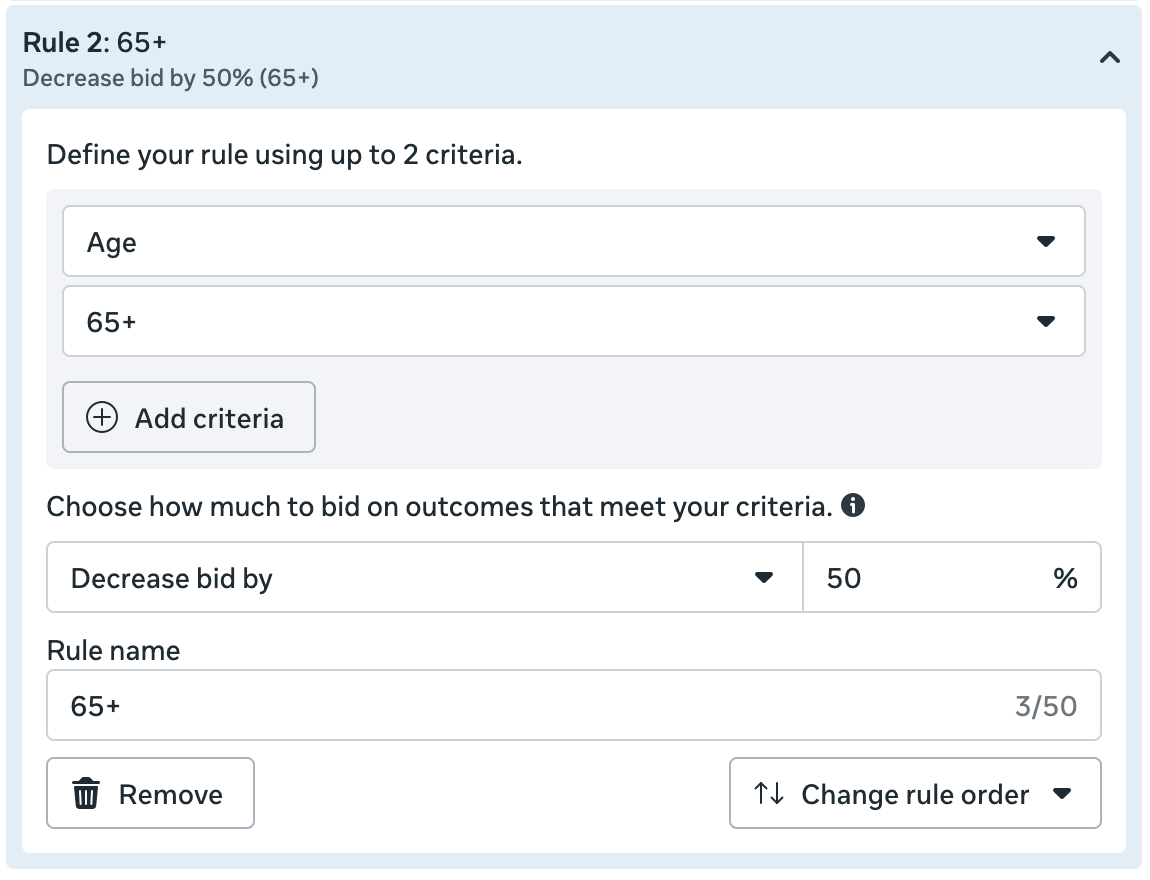
I’ve found that age range can be an inefficiency related to lead generation. For whatever reason, people over the age of 65 often complete forms at a lower cost per lead. And as far as Meta knows, that’s a good thing.
But it isn’t necessarily if those cheap leads are low quality. While restricting by age may seem like the logical solution, it can backfire. You also may not want to restrict an age group completely.
Use breakdowns by age to see if you have a problem related to age distribution in the first place. And make sure you have data on the back end that proves these leads are lower quality. If they are, consider applying a value rule by age range.
Gender
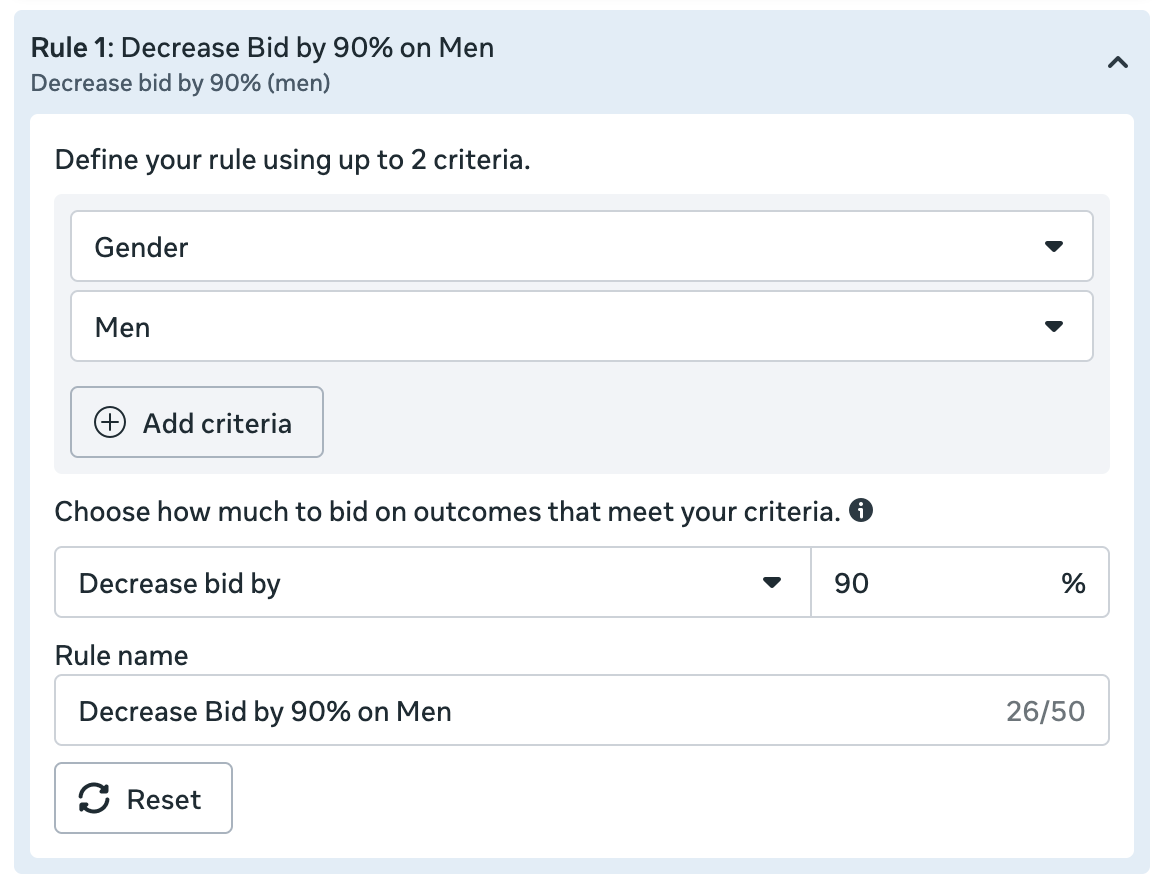
Even if you serve predominantly men or women, don’t assume that you need to restrict by gender. Use the breakdown by gender to see how results and ad spend are distributed. Also verify how lead value differs by gender before acting.
Avoid restricting by gender if you can. If there’s a problem to be solved, prioritize using a value rule to adjust bids by gender.
Form Quality Control Options
Go back to your analysis of lead quality that we discussed near the beginning. What are the common themes?
The reality is that we want to limit unnecessary friction generated with our lead forms. The reason for adding friction would be to improve lead quality.
The fewer the questions you ask, the more leads you’re likely to get. If you only ask for a first name and email address, it will likely cost less than if you also ask for last name and a phone number. So if you ask for that additional information, make sure that there’s an exchange of value.
Here are a few ways to address lead quality with your forms…
- Ask qualifying questions
- Add SMS verification for phone calls
- Use conditional logic to filter out bad leads
- Require a work email if you are B2B
You can also get creative with website forms, though it may require some programming. If people answer questions in ways that are disqualifying, you can have the form completion redirect to a different confirmation page. That way, you can have the lead event only fire for qualified leads.
Lead Magnet Options
Maybe this is obvious, but the lead magnet you offer will almost always impact the quality of your leads. It needs to be desirable, but it should also be highly relevant to your business offerings.
This is why many contests and giveaways miss the mark. A business may offer an iPad or some other irrelevant, but desirable, product in exchange for contact information. But if that iPad has nothing to do with the business services, the lead is likely to be worthless.
Maybe you can offer the first lesson of a 10-lesson course for free. Or the first chapter of a book. The more obviously linked the upsell is to the lead magnet, the higher the success rate is likely to be.
Track and Optimize for Qualified Actions
What action can a new lead take that proves they are a quality lead? While this can be a purchase, such an action may not always happen right away. You don’t need to start that far down the funnel.
Something I track is whether a lead clicks a link in my emails. It doesn’t have to be the first email. A new lead will have multiple opportunities to open my emails during the first month. If they don’t click a link in any of them, they aren’t a qualified lead.
This is especially easy when the link is to access the lead magnet. While I may not know the value of a lead for months or years, I can at least make some assumptions based on those initial actions.
I created CRM automations and apply tags when new leads click a link within the first 30 days. If they do, they are marked as a “Quality Lead” and an event is sent to Meta. That allows me to add a column to my reporting to see how many of the people subscribing are quality leads.
This also gives me the option of optimizing for the Quality Lead custom event, rather than the lead itself.

This is something I experiment with often. But it doesn’t always improve the ultimate cost per quality lead.
Lead Outreach Process
Finally, the quality of your leads may not be the problem at all. Maybe you pass the leads on to a sales team, and they’re telling you that they are garbage.
But maybe it’s the outreach process that is the problem.
What automations do you have in place once someone completes your form? Are they emailed immediately? Texted to let them know you’ll be calling? How long until they’re contacted?
How is the sales script? What’s the quality of the salespeople? Is the problem actually with those who are tasked to close the sale?
It’s easy to label leads as being low quality because they’re unreachable, but this often misses the reality of the challenges that exist today. There are many things you can do to address these challenges.
Your marketing emails may go to spam and “other” folders. Review your emails and sender to limit your risk of triggering these filters. Make it clear on the confirmation page that they may need to check spam and other folders for your important email.
Many people don’t even take phone calls from unknown senders. These calls are silenced and go straight to voicemail. Send an initial text that asks the lead to respond. Even better, have them add you to their contact list so that they’ll receive your call.
It’s a Science
Lead generation is a science, and how it’s approached will vary depending on the business. But there are some common themes:
- Know the average value of a lead
- Know what makes a lead low quality
- Address the low quality factors the best you can
- Only add friction when it’s in exchange for lead quality
- Do not ignore the post-lead outreach
You may never come up with a “final” approach to lead generation. You’ll analyze, tweak, and adjust to try to maintain that perfect balance of cost and value.
And that’s part of the fun of it.
Your Turn
How do you approach lead generation?
Let me know in the comments below!