
Audience Segments are one of my favorite tools. They uncovered information that completely transformed my understanding of algorithmic targeting and my approach to remarketing specifically.
While what you see may not change all that much from day to day or week to week, the data remains valuable. It can validate your approach and even help you understand why one campaign, ad set, or ad is currently outperforming another.
What to Expect
I generally see around 20-25% of my budget spent on remarketing (Engaged Audience + Existing Customers), but this can vary. I’ll especially see a higher percentage for new campaigns, ad sets, or ads, as Meta prioritizes people most likely to convert. But this percentage tends to drop with time.
What you see will depend on four key factors:
- The size of your Engaged Audience
- The size of your Existing Customers
- The performance goal
- Budget
I have a highly engaged email list and get around 100,000 website views per month, so my Engaged Audience is larger than average. This certainly impacts the potential percentage of my budget spent on remarketing via algorithmic targeting.
What you spend certainly matters, too. If your Audience Segments are small and you’re spending thousands of dollars per day, you can expect a much smaller percentage of your budget to be spent on those audiences. You have a limited resource.
I’ve also seen that the performance goal can impact how much Meta prioritizes remarketing. While you must use the Sales objective to utilize this feature, there are many performance goals that you can use that aren’t sales-specific. Generally, I’ll see a higher percentage of my budget dedicated to remarketing for the bottom of the funnel, and those percentages decrease as we move up the funnel.
What it Says About Remarketing
This, to me, is the most important value of Audience Segments.
When I learn that an advertiser still uses remarketing as a core part of their strategy because they either don’t trust algorithmic targeting or think Meta won’t otherwise reach these people, I automatically know that they do not use Audience Segments. When you do, it will likely change your outlook.
If you know that Meta automatically spends anywhere from 10 to 40% of your budget (depending on the situation) on remarketing, what’s the point of that separate remarketing campaign? Meta is already reaching those people, so you’re likely trying to reach them twice. This results in unnecessary auction overlap.
Meta wants you to get good results, so your remarketing audiences will be prioritized by default. When you’re able to prove this to yourself, it changes your thought process when setting up a campaign.
Another benefit this uncovers is that Meta dynamically adjusts your remarketing concentration. Meta has to account for costs, frequency, and the likelihood your desired action will be performed. So you may see 75% go to prospecting and 25% to remarketing early, or that may shift to more of an 85% to 15% split later on.
While there are rare exceptions when remarketing makes sense, the vast majority of reasons we use these strategies are now obsolete. There’s no reason to use general remarketing strategies anymore. This is when you’d target your website visitors, email list, and page engagement because you see those groups as the people most likely to convert.
Well, Meta sees those people as those most likely to convert, too. You don’t need to isolate these groups. And when you take your hands off, you give the algorithm freedom that limits unnecessary costs due to restrictions.
What it Says About Algorithmic Targeting
This is the secondary benefit of Audience Segments. They validate that algorithmic targeting has logical direction.
It would be like if you could break down your results when not using any inputs at all and see that a portion of your audience matched a lookalike audience of your customers. Or you could see that they had similar job titles and characteristics of your ideal customers.
You can’t do any of that, which is why advertisers have long distrusted a hands-off approach to targeting. Beyond relying on the results themselves, there have been few ways to verify that Meta’s actually showing your ads to the right people.
That’s why this helps. If we know that 25% of our budget was automatically spent on remarketing because Meta knows those people are most likely to convert, it’s much easier to trust the composition of the other 75%.
And that’s where I fall these days. While I fully understand there are weaknesses in the algorithm, I know what to look for. And I have a general trust that my ads are being shown to the right people.
Thanks to Audience Segments, this isn’t a blind trust. It’s trust based in data.
Where Did Results Come From?
Beyond simply knowing that a percentage of your budget is spent on remarketing, you can also see what percentage of your results came from that group. And that may be just as important.
It could be discouraging if you were to see that all of your results came from remarketing. But that’s not what I see at all. In fact, I often see results come from the “New Audience” at similar costs.
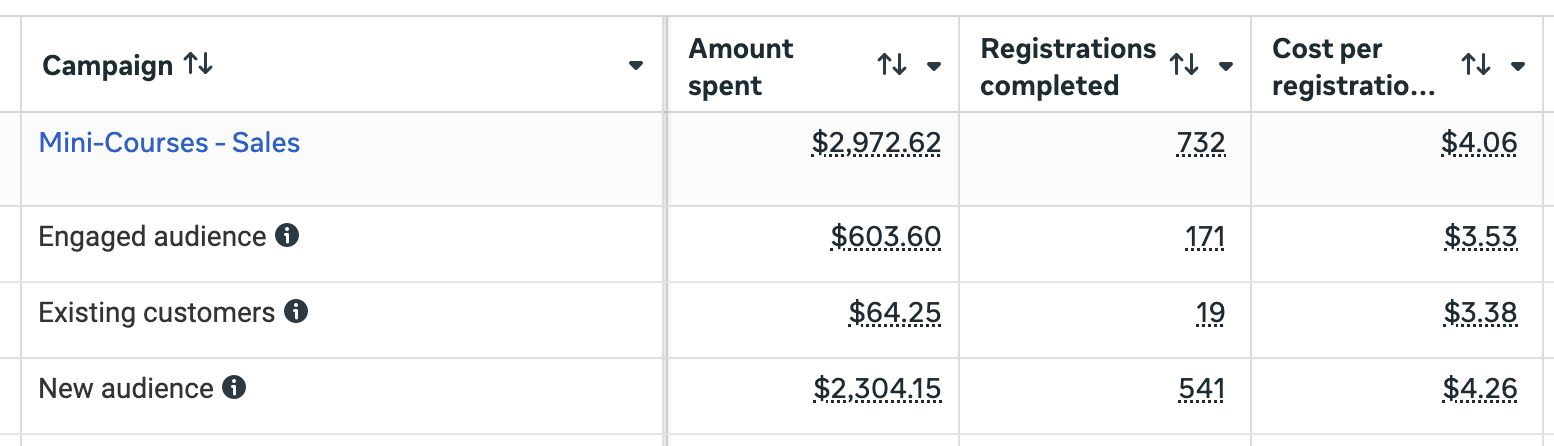
It makes logical sense that I’d get better costs from my Engaged Audience and Existing Customers. But as you can see in this example, the difference isn’t dramatic. While 22% of the budget was spent on remarketing, results came at a similar split (25%). I wasn’t relying entirely on my Engaged Audience and Existing Customers.
Source of View-Through Conversions
One of the reasons I’m not a fan of strict remarketing campaigns is that the results tend to be misleading. Meta will lean heavily into view-through conversions, many of which would have happened without the ads.
Of course, this can potentially happen when using algorithmic targeting, too. While view-through conversions aren’t generally seen as a problem for a new audience, you can uncover where exactly they’re coming from to make sure that they’re not padding your results from the remarketing audiences.
You would use the Compare Attribution Settings feature in addition to the breakdown by Audience Segments to see this.
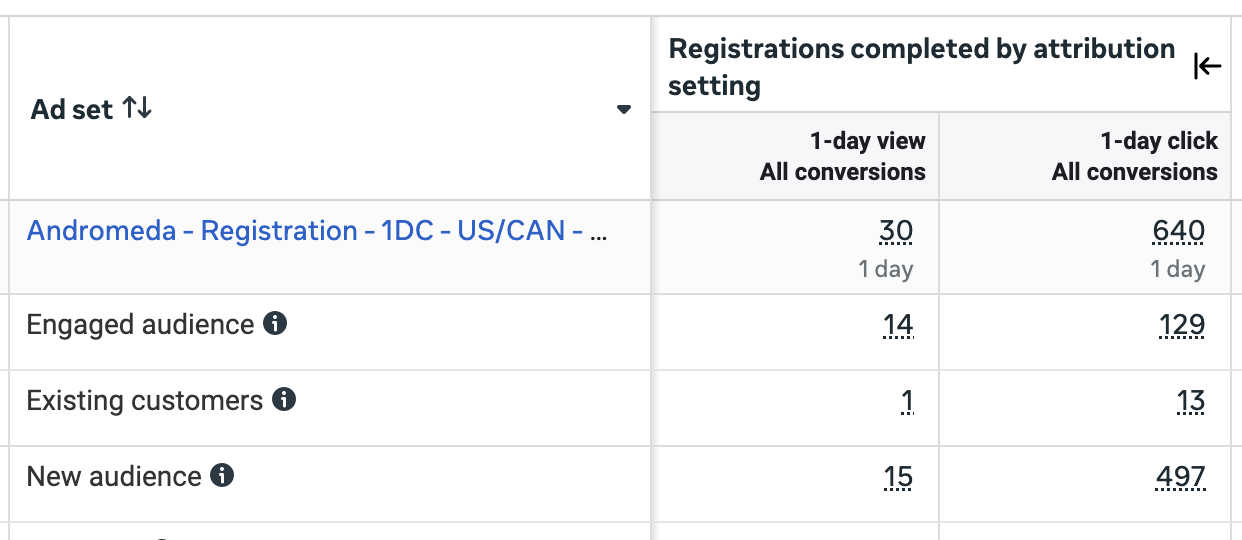
In the example above, the same number of view-through conversions are coming from both remarketing and prospecting. For obvious reasons, a higher percentage is coming from remarketing.
Impact on Costs
There are a few reasons why Meta might not spend more on remarketing by default. One is that these Audience Segments are finite, and Meta will eventually exhaust these groups. The other is that it’s inherently more expensive to target the remarketing group.
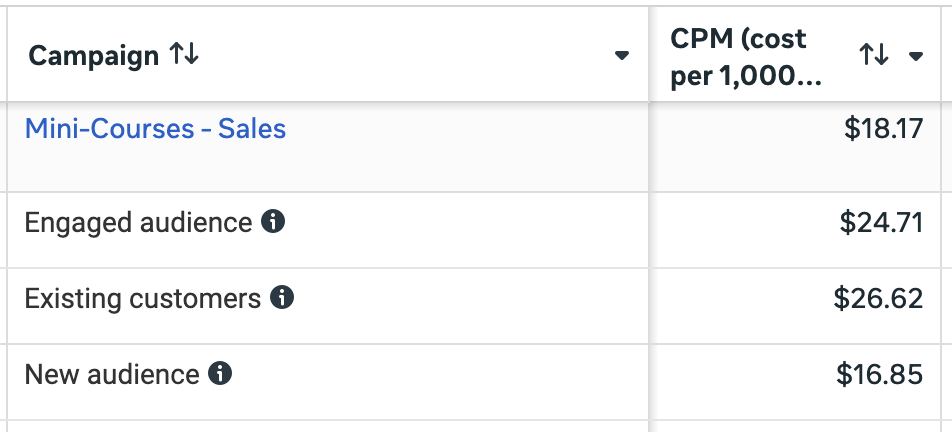
In the example above, I have an overall CPM of $18.17. But remarketing averages out at about a $25 CPM, while the New Audience is $16.85. That’s about a 33% difference.
Once again, this cost differential is something that Meta dynamically balances to determine who sees our ads. It might be more expensive to reach people in the Engaged Audience and Existing Customers, but they are more likely to convert. The New Audience provides far more options of people to show ads to, which limits costs.
If your CPM is higher than usual, this is one of the many factors to consider. Perform a breakdown by Audience Segments and you may see that more is being spent on remarketing.
New vs. Old Ads
It’s logical that Meta would dedicate a larger percentage of the budget to remarketing for new ads than for ads that have been running for a longer period of time. As you exhaust that finite audience, Meta will start dedicating more of your budget to the New Audience.
I see this consistently, and it can help explain performance changes. Here are the first seven days of an ad set, where 21% of the budget was spent on the Engaged Audience and Existing Customers.

And then three weeks later, where that percentage has dropped to under 17%.

We often hear advertisers complain of a scenario where their ads will start out strong and then decrease in effectiveness over time. While there might be multiple reasons for such a decline, this expected shift toward New Audience is an important factor.
Performance Variations
Once you’ve started spotting these variations in budget concentration on remarketing, you’ll look for them everywhere. And in many cases, this is a viable factor impacting performance variations.
It can explain why an ad set or ad started strong and declined. But it can also explain why one ad is performing better than another. It’s common to see different remarketing concentrations by ad, which will impact performance.
The main thing is to be aware of this factor so that you can highlight it when it’s part of the story behind results.
Is Control Necessary?
Another benefit of this breakdown is that it might actually highlight a problem. It’s possible that you might see Meta dedicating too much of your budget to remarketing.
While you should not ignore the expectation that this percentage is likely to come down with time, there are scenarios where a greater concentration in prospecting might be preferred. And if Meta is shifting too hard toward remarketing, you can consider creating separate ad sets (one to remarketing audiences and one to prospecting). Even then, I’d use CBO and consider an Ad Set Spending Limit on the remarketing ad set.
Get Creative
The bottom line is that there isn’t one single “right” way to use Audience Segments. This mini-course outlines my basic recommendations based on how I’ve found them to be most useful. But you may find other applications and ways to use them that work best for your situation.
I hope you find Audience Segments as valuable to your advertising as I have!
Power Hitters Club
Audience Segments Are Just the Start
If this course opened your eyes to what’s possible with Audience Segments, there’s a lot more where that came from. Inside Power Hitters Club – Elite, I go deep on the stuff most advertisers aren’t talking about — like how I use creative testing, Value Rules, and breakdowns to make better decisions every week. You also get a private community of advanced advertisers, weekly strategy sessions, and my Ad Briefs, which are living documents where I lay out my current approach and update them as things change. This is where the serious advertisers hang out.

