
Up to this point, I’ve helped you understand the various ways you can focus on generating more diverse creative. But it’s not as simple as simply doing everything that will make creative diverse. That’s crazy.
I’ve talked about building your ads in a way that’s in the spirit of creative diversity. And that sounds like sloppy advice without much substance. So I thought it might help if I shared how I’m approaching ad creation now.
Let me be clear that this is a moving target. I wouldn’t say that I have a single “proven system” for creating ads. And really, I’m generally skeptical of these types of universal claims anyway.
Every account and campaign is different. Or at least, there are different factors that impact how you approach things.
With that in mind, let me share some thoughts…
The Diversity Dilemma
When Andromeda and creative diversification became hot topics in early 2025, I did what a lot of advertisers did. I pushed the limits. I created 20, 30, and even 50 ads in an ad set.
But I quickly realized what a complete waste of time that was. Meta didn’t show all of the ads. Ultimately, the focus would go to a small handful. And when you spend all of that time, energy, and possibly money on ad creation, it’s a mistake you won’t make twice when that happens.
Now, I should be clear that how you approach this can and should be different depending on your budget and resources available. If you’re in the highest percentile of ad spend and a team of designers waiting for the next project, give them work to do. Create lots of ads. Make them as diverse as possible in terms of format, visual styles, and more.
But if you’re like most advertisers, you want to focus your time wisely. Creative diversification isn’t about creating more ads. It’s about providing options so that Meta can find the right group of assets for the right group of people.
My recommendation is to start small. You may not need more than a small handful of ads. The problem then becomes where to start. And that’s the diversity dilemma.
If you create an image ad with a solid background, what color do you use? Meta would say if you created multiple ads that were only different in color, they wouldn’t be considered diverse.
It makes sense to use videos for some ads and static images for others. Which one will be a video? Which will be a static image? Will you customize the format by placement?
Ultimately, there needs to be a starting point and some guesses. That’s the dilemma. But I have a way to approach this.
Creative Diversity Stack
Admittedly, this is a new concept I’ve been working through lately. But it works really well with my process.
I’m done creating 10 or 20 ads at once. It’s unnecessary. I look instead at creating my ads in multiple phases. Each of those phases will be similar in theme. By nature, they won’t be entirely diverse individually. But when you combine each phase of ads into a final stack, you’ll end up with creative diversity.
Let me explain with an example.
I started a new ad set to promote this very mini-course. When I did, I started with a single theme and concept. It consisted of the following:
- 5 primary text options
- 5 headlines
- 1 image concept
- 5 image variations by color combinations
This would mean five ads that would all use the same primary text and headline options, but would be different by color combinations. Again, these ads aren’t necessarily the diversity that Meta wants yet, and that’s okay.
Since it was a new ad set, I started it with a creative test using Meta’s creative testing tool. I was spending $100 per day, and I dedicated the entire $100 to the test — because they were the only ads.

This test will run for a week. When the test is done, delivery will shift from spending equally per ad to distributing optimally.
For the next week after the test, I watch and evaluate.
How is the ad set performing in aggregate?
What worked well?
What didn’t work well?
If it’s performing great in aggregate, I may not touch anything. If I feel it could be better, I move on to phase 2 to add to the stack.
Phase 2 will be five more ads utilizing a completely different them. Since the first group of ads were all static images, the next group would either focus entirely on videos or be less rigid in theme.
But the main key here is that everything about the ads in Phase 2 will be different from Phase 1. New formats, new messaging angles, new creative theme. It will have a completely different feel.
And then I’ll run another creative test of those new ads in the existing ad set, dedicating a portion of the budget to those ads. How I feel about the ads from Phase 1 will impact how I dedicate testing budget to these new ads since they’ll exist in the same ad set and share the budget.
For example, if Phase 1 went really well (and that’s what I’m seeing), I’ll dedicate 20% of the budget to the new ads. Since that limits my ability go generate meaningful results in a week, I’ll extend the test out to 14 days.
But if the ads in Phase 1 didn’t perform that great, I’ll assign a greater percentage of the budget to the test. And if that’s the case, I’ll probably get it wrapped up in a week.
When that test is done, the process repeats. I let things sit for another week or two and make an evaluation.
How is the ad set performing in aggregate?
What worked well?
What didn’t work well?
If I think there’s more room to grow, I move to phase 3, which will consist of another group of ads that are uniquely different in every way from the first two groups.
A Slow Build
In theory, each test may not be as diverse as Meta wants it to be. But that’s not my goal. I have questions I want answered with each group of ads. And I’m going to build slowly so that I don’t waste my time.
And I also learn from each test to help inform what I do with the next group of ads. This is much more strategic than trying to blindly build 20-50 ads from the start. I’m creating new ads only if I need to, and how I’m creating them is based on what I’ve learned from the prior tests.
You may also wonder why I start each phase with creative tests. The creative testing tool has become a part of my process for introducing all new ads. There’s a reason why I do this with new ads instead of waiting until later.
One weird quirk of the creative testing tool is that you can’t test existing ads. You’d need to duplicate existing ads and test them, which defeats the entire purpose. So one reason to start a test with new ads is that the ads that are tested are the same ads that will run after the test is over.
I also start new ads with a test because I know the question will inevitably come up weeks down the road: Why did Meta choose this ad and why won’t Meta show this other ad?
By running the tests, I get these questions answered before they come up. And if Meta’s distribution conflicts with the results of the test (which is possible), I can make informed decisions if I’m not getting the results that I want.
Spirit of Diversity
Whether you use my process or your own, the main thing is to approach ad creation in the spirit of diversity. Always look for ways to add more options.
I mentioned it before, but something I do more often now is that I’ll create a single ad that utilizes both images and videos. I do this by using static images for all feed placements and 9×16 videos for all stories and reels.
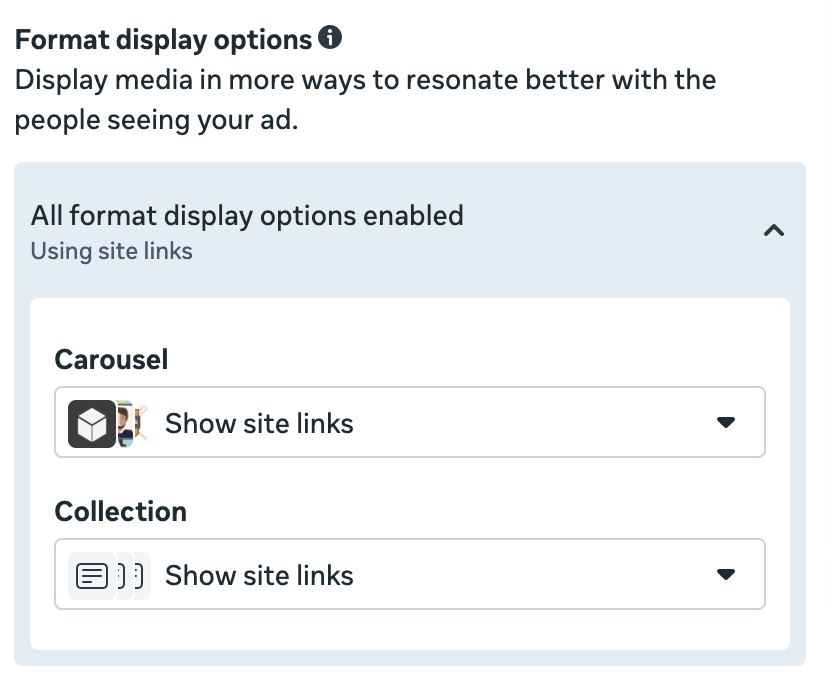
Something else I do is customize site links and accept the format display options to generate a carousel and collection version.
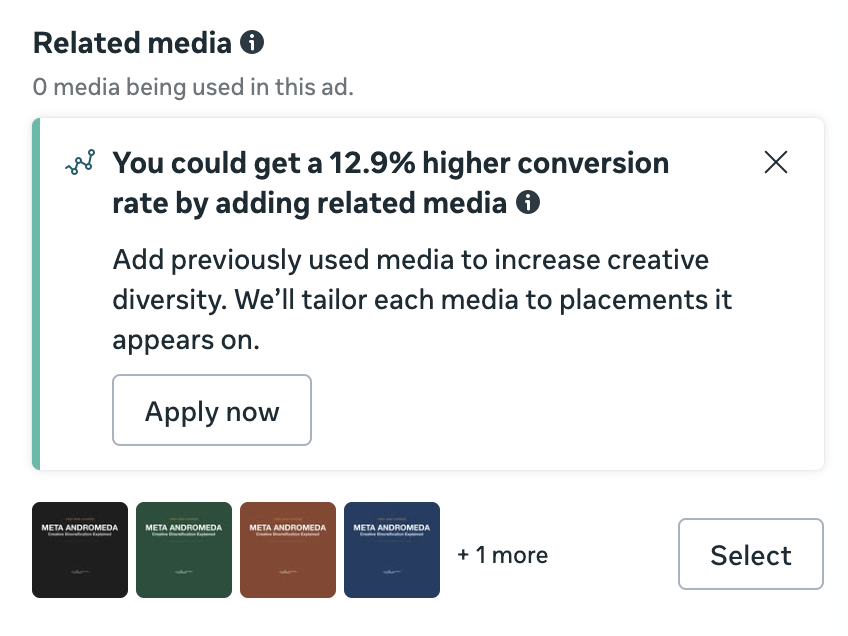
And there are times when I’ll accept the related media to add more images or videos to the options that Meta can choose from.
The main thing is to be open to these options because they can help generate more variations. And that’s ultimately what you want — and what Meta wants.
Creative diversification is a stronger lever now than targeting inputs for impacting who sees your ads. If you create one version of your ads for one group of people, a smaller group of people is likely to convert.
But if you build your ads with creative diversity in mind related to images, videos, visuals, customer personas, text, offers, and more, you can reach multiple groups of people with different combinations of your ads.
And this is also why you shouldn’t obsess over things like which headline, primary text, or even creative element performed best. There will be potentially thousands of combinations of copy and creative that will be used. Your job is to provide as many good assets as possible so that Meta can combine them to reach the most people.
You Can Do This!
Ultimately, this isn’t particularly complicated, but it is a huge divergence from the way advertisers used to do things — and the way many do things now. But you absolutely can do this. When you get a hang of it, you’ll also see the impact.
Your ads will last longer. They won’t fatigue. And they’ll appeal to larger groups of people.
While I think we oversell what Andromeda actually does (many advertisers talk as if it impacts everything), it truly did change my approach to ads. Focus less on your campaign and ad set. Keep that as simple as possible. And focus the bulk of your energies on the ads.
If you aren’t getting great results, it’s not your campaign construction or ad set. It’s your ads. Create new and better ones that appeal to your target audience.
And those ads, as we know, can always be better.
Free Mini-Course
Want to Understand Modern Targeting, Too?
Andromeda is about getting the right creative in front of the right person. But what happened to all those targeting levers you used to rely on? In my free Modern Targeting mini-course, I break down exactly what changed with audiences, demographics, lookalikes, and remarketing — and what actually matters now. If you’re learning Andromeda, this is the other half of the equation.

