You have a high-performing campaign, and increase the budget. Then performance tanks.
Do you know why this happens?
The biggest problem is that advertisers incorrectly label high-performing campaigns in the first place. Here’s how to find one worth scaling…
1. Isolate 1-Day Click Results
Use the breakdown by attribution settings.
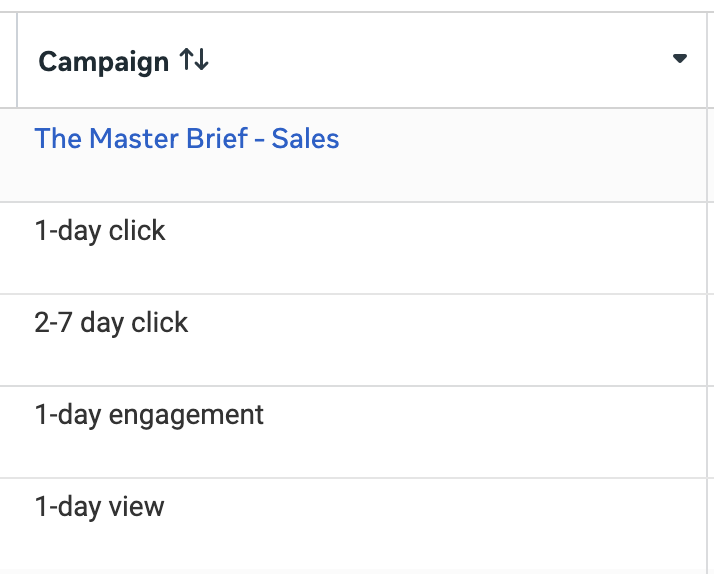
Ignore view-through, engage-through, and 7-day click conversions. It’s not that these numbers are worthless (and you shouldn’t ignore them completely in normal situations), but results from these attribution settings are bad predictors of scalable performance.
Is the performance from 1-day click alone good enough? Or is it only high-performing if you consider the other attribution settings?
2. Isolate New Audience Results
Make sure that your audience segments are defined thoroughly. Your engaged audience should include the broadest audience of people who have engaged with you. I use a 180-day website custom audience for all website visitors and my entire email list. I define existing customers with a 730-day website custom audience of purchases and the email list of paying customers.
Then do a breakdown by audience segments. It’s important that your segments are defined thoroughly so that this breakdown provides accurate results.
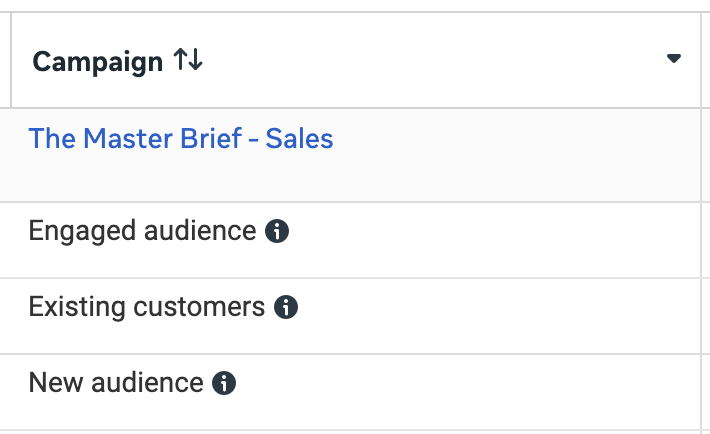
Ignore results from the engaged audience and existing customers. Once again, results that come from remarketing have value. But they’re bad indicators for scalability.
Is the performance from the new audience good enough by itself? Or is it only high-performing because of remarketing results?
Why This Matters
More often than not, the campaigns we think are performing amazingly are actually propped up by remarketing. These audiences will be exhausted and aren’t scalable.
View-through, engage-through, and even 7-day click are all often beneficiaries of remarketing. They may have seen, engaged, or clicked your ad, but another marketing channel ultimately drove the conversion.
But the new audience and 1-day click conversions are important indicators. If you’re getting a high volume of results at a good cost and return from prospecting audiences, this is a great sign. These audiences won’t burn out the way remarketing does.
If you see good performance there, you’re safe to scale.
What to Expect
When you scale a campaign, costs should align most consistently with your new audience reporting. That’s why it’s so important to isolate these results before increasing the budget. Quite often, what we think is a high-performing campaign no longer is when focusing only on the new audience segment.
But your costs are likely to be even a little worse than that new audience baseline, depending on how much you’re scaling your budget. Meta prioritizes people most likely to convert, so that net will need to be expanded when spending more.
Something else to remember is that even the “new audience” segment includes some remarketing that can’t be classified as either an engaged audience or existing customer. People who only engage with your content on Facebook and Instagram, for example, would be considered part of your “new audience.” And this audience can be exhausted.
It’s another reason why it’s so important to define those audience segments so thoroughly. If you define them narrowly, you can be misled by results from what appears to be a new audience. In reality, it includes remarketing that you failed to define.
This is a good exercise to find a campaign worth scaling instead of blindly basing it only on surface-level results. You’ll assume that there’s something wrong with Meta or the algorithm or restarting the learning phase, when there was a very logical reason for performance drops all along.
Now you can predict the drops and avoid them.