


When your ads aren’t converting, what should you do? Consider this blog post your starting point.
Don’t waste your time on magical strategies or hacks. There is no campaign construction that will magically make your ads work. Stop falling for this belief.
If you’re not getting results, start with the items you can troubleshoot yourself. If people aren’t clicking on your ads, why not? If they’re clicking, why aren’t they converting? And if they’re converting, why aren’t the conversions being attributed to your ads?
This is your working checklist for troubleshooting and improved ad performance…
1. Why Aren’t People Clicking?
This is generally a problem with the clearest solutions. If people aren’t clicking your ads, there’s a fundamental issue (or several issues) with your message.
Conduct a critical analysis of your ads. Be honest with yourself, and do your best to separate yourself from the ads themselves. If you refuse to admit your ads’ shortcomings, you’ll find yourself in a perpetual loop.
If people aren’t clicking your ads, the cause almost never has anything to do with your targeting or performance goal. While no ad is guaranteed conversions, you should get clicks. And if that’s not happening, start with these things…
Budget
Any discussion of “good” and “bad” CTR is problematic without context. The type of click matters (any click, click on a link, or click on an outbound link), but lots of clicks doesn’t necessarily mean you’re driving the right traffic either. But you can generally expect a CTR on outbound links of anywhere from 1 to 5%.
With that said, a combination of your budget and CPM will significantly impact the volume of clicks. If the CPM is $50 and you’re spending $25 per day, you may only see 10-15 clicks on a daily basis. And that low volume may have nothing to do with your ads themselves.
Ad Creative
Does your ad creative grab the attention of your potential customer? Is it boring? Too busy? Obviously AI-generated? Is it clear what your ad is promoting?
Be critical of the image or video that you’re using. If you were watching it, would it grab your attention? Would you be inspired to click or ignore it?
Is it clear who this creative is intended for?
Ad Copy
While the copy isn’t always the focus, depending on the placement, it can be especially important in certain feeds. Your ad copy is a critical component.
If your copy is simply a list or retelling of your product benefits, you’re missing an opportunity. It’s a boring approach, and you shouldn’t expect many clicks.
This is where it’s helpful to think about the psychology of sales. Who are your various customer personas? What are their pain points? How is your product the solution? And how will they feel when that problem is solved?
Your ad copy is a balancing act. It needs to be clear about who it’s for and the problem you’re solving, without being overly verbose or confusing. You may be able to do this with a single line or several paragraphs.
Offer
The offer is ultimately what’s highlighted in the ad copy and creative. This is what adds a sense of urgency, typically due to scarcity or a time-sensitive price. It could also be a secretive offer that only certain people are getting.
Do not lie or mislead about how many are available or when the offer expires. People can often sniff that out, and your customers won’t be happy if they find out later that they were lied to.
You also don’t technically need a discount. Think of ways to position your product in new and exciting ways.
2. Why Aren’t People Who Click Converting?
Maybe you’re getting plenty of clicks, but they’re not resulting in conversions. Understanding why people aren’t converting can be a bit more complicated. There are likely to be several contributing factors.
Performance Goal
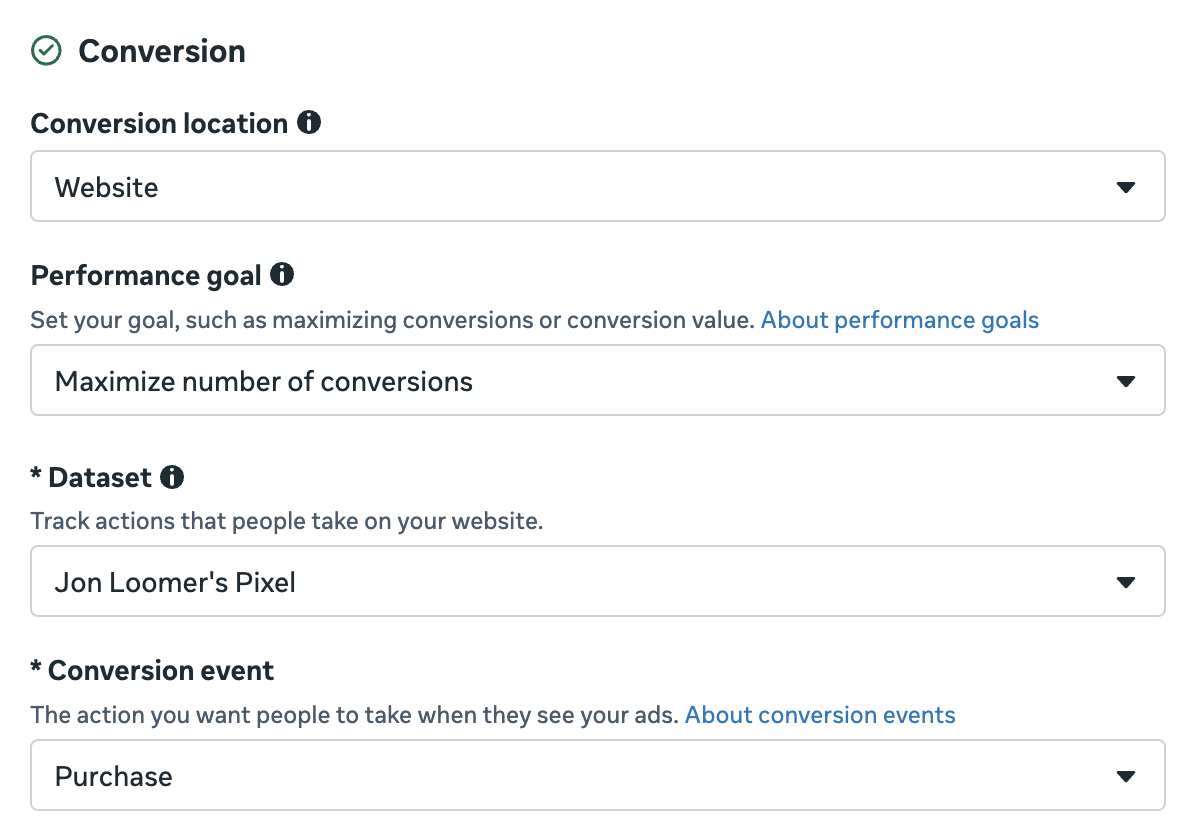
Make sure you get this one out of the way first. The performance goal is defined in the ad set. It’s important to remember that the Meta ads delivery algorithm is literal. It will try to get you the action you define with the performance goal, and nothing more.
So if you get cute and set a performance goal that prioritizes reach, link clicks, landing page views, ThruPlay views, or some action other than the actual action that you want, expect to get a whole lot of empty engagement. This even tends to apply to funnel actions like initiate checkout and add to cart. You’ll get those actions, but not the action you want. That’s just how it works.
If you want a purchase, use a performance goal that maximizes the number or value of conversions, where the conversion event is a purchase.
Confirm Linked Page
Maybe obvious, but one of the most overlooked causes for bad performance.
What page does your ad link to? Is it a broken link? Are you using the correct URL? Are you linking to the website home page or a page that would be most relevant to the ad people are clicking on?
You want people who land on this page to feel like it’s a continuation of your ad. Do they immediately see the product that interested them in their ad, or are they expected to click around to find it?
Landing Page Performance
Easy to miss. How long does it take your landing page to load? If it takes a second too long, potential customers will abandon the experience and move on to something else.
Loading times are only partly in your control, of course. The strength of the user’s connection is important, too. But you want your page to load as quickly and efficiently as possible to limit any potential issues.
Beyond load time of the page itself, give attention to the clicks that happen once someone is on the page. Does each click immediately load the expected experience? Or does load lag or break?
The more complicated this process and the more clicks that are required to complete a purchase, the more possibilities for something to go wrong.
Landing Page Messaging Flow
While landing page performance is more about load times and functionality, messaging flow is aligned more with design. It’s a critical component.
When someone lands on the page, do they immediately know what to do? An overcomplicated landing page can be a death sentence for conversions. Make sure that it’s simple enough so a visitor is gently guided to exactly where they need to go, while having enough information that there won’t be any unanswered questions.
Avoid too many options or unnecessary information that could create confusion. There is psychology to the options you provide, but you can also get in your own way.
Are the messaging and imagery consistent with what was in the ad? Or does it feel like they’re on a page for a completely different product? Consistency is important.
Pricing Issues
In some cases, the issue may not be an “issue” at all. If you have a high-priced product, you should not expect a high volume of purchases or a high conversion rate.
Otherwise, it’s possible that your product is priced too high. Everything about your ad and landing page could otherwise be solid, but an improper price may kill conversion rate.
I’ve also seen landing pages where pricing is confusing, if not mostly hidden. Do not run from your price. It needs to be clear and obvious. Make the potential customer search for it, and they will quickly lose trust and abandon your website.
3. Why Aren’t Conversions Being Reported?
Of course, it’s also possible that everything with your ads and landing page are strong. You know that conversions are happening, but they aren’t being reported in Ads Manager.
This is a problem, not just so that you know how ads are performing, but so that Meta does. When Meta knows that conversions can be attributed to your ads, it improves the information available to show ads to more relevant people. Otherwise, without conversion information, the assumption is that your ads aren’t working.
If you know that conversions are happening that should be attributed to your ads, but they aren’t appearing in Ads Manager, start here…
Your Pixel
Is your pixel properly installed on your website? Does it fire on every page of your website? This is the bare minimum, and I often take for granted that every website has this set up correctly.
Your Events
Are you using standard events that fire after a conversion is completed? While you can certainly use custom events, only resort to them if there isn’t a standard event that could define your conversion. And custom conversions shouldn’t be used in place of either standard or custom events. They’re for segmenting your reporting by product, category, price, or something else.
Test the process of clicking your ad through the completion of a conversion and verify that all events fire as expected and when expected.
Your CRM and API Events
The easiest way to send web API events is now using Meta’s one-click, no cost solution. There’s no longer an excuse for not having Conversions API set up at all.
If you also send CRM events that can’t be defined with web activity, make sure that they are sending properly for standard events. Also confirm that you’re sending as much information as possible so Meta can match events to users and help with attribution.
The Problem With Blaming Meta
When you aren’t getting the results you want, you may be tempted to tweak the things that matter least. Don’t assume that the problem must be solved with some magical campaign construction, ad set setting, or other mechanical adjustment. While you can hurt results by overcomplicating, you will almost never find a solution this way.
The other most common reaction is to blame Meta. Nothing could be less productive. Your results aren’t bad because Meta wants them to be bad. You aren’t wasting money because the algorithm has decided to punish you. Blaming Meta is no more productive than blaming Santa Claus.
The items above all give you power. When you aren’t getting the results you want in aggregate, start with the steps highlighted in this post. They are all within your control. Most importantly, they all make an impact.
Your Turn
Anything else you’d add?
Let me know in the comments below!